
From the Akhada to the Broadcast: Kabaddi's Economy, Culture and the Next Challenge
कबड्डी क्या है? — सात-सात खिलाड़ियों की दो टीमों का संपर्क खेल, जिसमें रेडर विपक्षी आधे हिस्से में जाकर टच करके लौटता है और डिफेंडर उसे रोकते हैं। भारत में आधुनिक युग कब शुरू हुआ? — 2014 में प्रो कबड्डी लीग की शुरुआत के साथ, जिसने प्रसारण, फ्रैंचाइज़ी मॉडल और खिलाड़ियों की आय को बदल दिया। प्रमुख अंतरराष्ट्रीय प्रतिस्पर्धी कौन हैं? — भारत, ईरान, बांग्लादेश, दक्षिण कोरिया, नेपाल, श्रीलंका, केन्या और पोलैंड। एशियाई खेलों में कबड्डी कब शामिल हुआ? — 1990 बीजिंग एशियाई खेलों से यह आधिकारिक मेडल इवेंट है। मुख्य चुनौतियाँ क्या हैं? — कमज़ोर घरेलू सर्किट, महिला लीग का अभाव, खेल विज्ञान और चोट प्रबंधन की असमान उपलब्धता, तथा प्रशासनिक पारदर्शिता। क्या कबड्डी ओलंपिक में है? — नहीं। वैश्विक स्तर पर प्रतिस्पर्धी गहराई सीमित होने के कारण शामिल कराना कठिन है।
Kabaddi has to be seen as two sports at once. The first is played in a mud pit in a village, where the rules live in oral tradition and spectators stand two paces away. The second is built for the camera — on a mat, with a thirty-second raid clock, slow-motion replays and layers of graphics and commentary. Nearly every argument about kabaddi in India emerges from the tension between these two forms: on one side the sport's popularity and cultural roots, on the other the need to turn it into a modern, professional, broadcastable product.
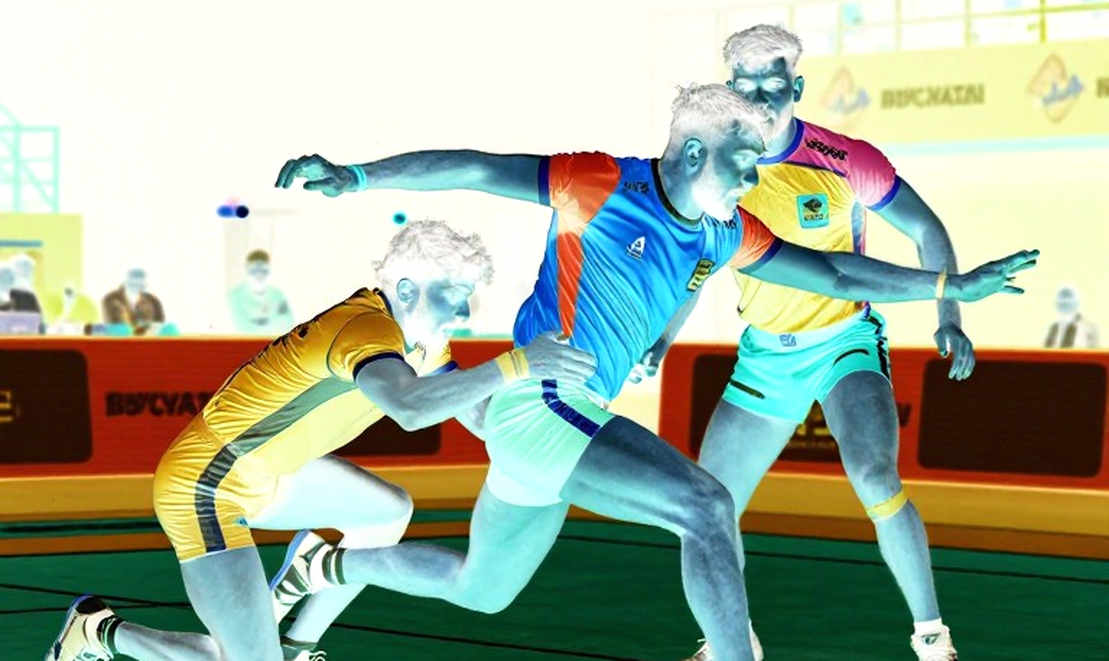
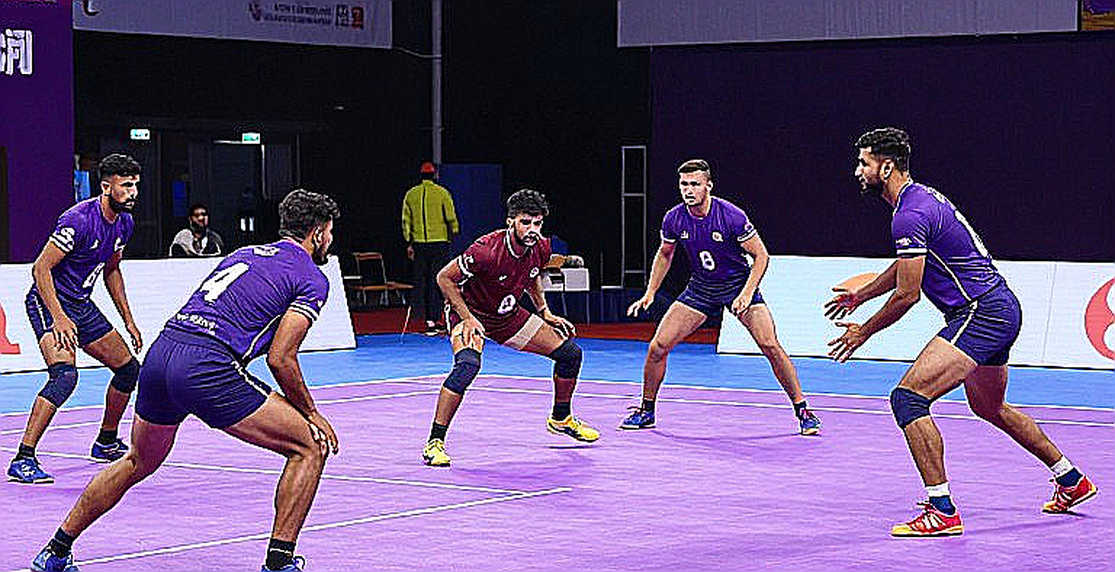
The basic structure of the game is simple enough to explain in a minute, and hard enough that years do not exhaust it. Two teams, seven players each on the mat at a time. The raider must cross into the opponent's half chanting kabaddi, touch a defender and return to his own side before his breath runs out. The defenders' job is to stop him — by catching a waist or a leg, or by using body weight to pin him inside the boundary. Sending the entire opposing unit out earns bonus points, and the side that holds the lead at the end wins.
The simplicity is deceptive. Kabaddi is a sport in which every raid is a small strategic problem. The raider has thirty seconds, but his real constraint is his lung. He must decide which defender to attack, whether to take a touch and escape towards the edge, or to cross the bonus line and collect a point. The defence in front of him is itself divided into three parts — corners, covers and ankles — and each carries its own risk and reward. An ankle-hold defender who is a fraction late lets the raider through; a fraction early and he is out himself. The beauty of kabaddi lives in that micro-decision, which happens on camera in a tenth of a second.
There is also the question of surface. On mud the game is slower, heavier and more physical; the raider relies on slipping out and using a defender's momentum. On the mat the pace rises, dives and slides become more visible, and the loading pattern on ankles and knees changes. Traditionalists often regard the mat version as less authentic, while the broadcast world treats the mat as standard because cameras, injury management and surface consistency are all easier there. The debate sounds technical, but it goes straight to the sport's identity.
Outside India the map of kabaddi is larger than the average viewer assumes. In Bangladesh it is the national sport, and it is also played in local forms such as ha-du-du. In Iran it is organised at school and club level, and over the past two decades a strong high-performance structure has been built there. In Nepal, Sri Lanka, Pakistan and Afghanistan its popularity is old. Beyond that, organised kabaddi activity exists in South Korea, Japan, Thailand, Malaysia, Kenya, Uganda, Poland, Britain and the United States. Kabaddi became an official medal event at the 2026 Beijing Asian Games and has been a permanent part of the Games since.
For a long time the international story was one-sided. India has been the most successful country at the Asian Games in both the men's and women's categories. But in recent years that monopoly has broken. Iran's men have beaten India at major tournaments and have finished above them in the medal table on more than one occasion. The reason is not merely talent but structure: Iran developed defence as a specialisation, while Indian teams have traditionally leaned on the depth of their raiding. When the two models meet, the contest becomes fast, physical and genuinely close.
To understand the economics of modern kabaddi, the Pro Kabaddi League is unavoidable. Launched in 2026 on a franchise model — eight teams at first, twelve later — it changed three things. First, player incomes: men who once made a living through government jobs or departmental teams can now reach substantial sums through an auction. Second, visibility: the league put the sport in prime time and used production values to make it watchable for audiences with no traditional connection to it. Third, identity: players became faces of brands, not only of states.
The league's effect, however, is not uniformly positive. Its calendar has become so central that national camps, the domestic circuit and international commitments frequently collide. A player injured in the league loses preparation time with the national side. The league format also tends to strengthen the entertainment side of the sport, while investment in coaching and sports science has not grown in proportion. Former players make this criticism often, and it has force: the league created demand, but the base of supply — school, college and district-level competition — did not grow as fast.
The league also accelerated the international exchange of the game. Iranian defenders are counted among the most influential foreign players on the Indian domestic circuit, and their presence gave young Indian defenders a direct route to learning. Indian raiders, in turn, grew used to playing against Iranian and Korean defences, which helped in international fixtures. Players from countries such as Kenya, Uganda and Poland finding places in the league has also strengthened domestic structures back home.
Women's kabaddi is the least examined part of this picture. Internationally the Indian women's team has been consistently strong and its Asian Games record is excellent. The states are not short of talent — players from Tamil Nadu, Haryana, Maharashtra, Odisha and Kerala have made their mark nationally. The problem is visibility and money. Whatever scale the men's league reached, no parallel platform was built for women. Until a stable, televised women's league exists domestically, talent will keep struggling to stay in the sport.
Stars have contributed a great deal to kabaddi's popularity. Players such as Anup Kumar became the embodiment of the captain figure, read on the mat for tactical understanding and calm. The raiding of Ajay Thakur and Rahul Chaudhari connected a generation to the game. Pardeep Narwal presented raiding in a distinct, almost theatrical style, and younger raiders such as Naveen Kumar showed how speed and balance can work together. Among foreign players, defenders such as Fazel Atrachali are familiar names to Indian audiences too. This star system helps marketing, but carries a risk — team depth and collective strategy often disappear behind individual performance.
The real challenge lies off the mat. In India, kabaddi's supply chain begins in villages and districts — at fairs, on school sports days, in akhadas beside the market. That structure is alive but unorganised. Talent scouting still runs, in large part, on word of mouth. Access to sports science is uneven: some franchises have strength and conditioning coaches, physios and video analysts, while state teams often do not. Kabaddi's injury burden is not small — knees, ankles and shoulders are most affected — and without load management a player's career shortens.
Administratively the sport runs between two structures: the International Kabaddi Federation, which sets global rules and the calendar, and national federations, which handle domestic selection and competition. In India, administrative disputes within the national federation have surfaced from time to time, affecting selection processes and player confidence. That is not good for any sport. The stronger the transparent selection criteria, public data and grievance mechanisms, the greater the trust players place in administration.
There has long been a demand to bring kabaddi into the Olympics, and it is emotionally natural — a sport rooted in Asia deserves an Olympic stage. The reality is harder. Places on the Olympic programme require meeting standards on global participation, broadcast value, gender equity and anti-doping frameworks. Kabaddi has a strong base in Asia, but competitive depth in Africa, Europe and the Americas is limited. That does not mean the effort should stop — it means investment should go where it matches those standards: expanding international competition, standardising coach education and raising the quality, not just the count, of member nations.
Kabaddi's greatest strength is that it does not need expensive facilities. A flat piece of ground, a lime line and seven players are enough. That is also its greatest weakness — because what is easily available is hard to give commercial value to. In the coming decade the question will not be whether kabaddi is popular; it is. The question will be whether it has a structure that lets a good raider be more than a good raider — a professional with a career, protection and a future. The answer will not be found in broadcast rights, but in the district akhada where the next generation is playing today.
संबंधित खिलाड़ी
लोकप्रिय/पसंदीदा पुस्तकें
The Jakarta Software: Which Mistake Indian Kabaddi Is Walking Into Before Nagoya 20262026-11-01
Commonwealth Kabaddi Championship 2026, Day 1: The Points Table's Arithmetic Is Right, Its Ordering Is Not2026-10-25
Every Column Reads N/A: Kabaddi's Real Crisis Isn't the Raider, It's the Record Room2026-10-24
From the Akhada to the Broadcast: Kabaddi's Economy, Culture and the Next Challenge2026-11-01
Kabaddi's New Era: From the Akhada to Data, How Strategy Is Reshaping the Sport2026-10-31
The Spreadsheet Had Already Won Before the Auction Room Opened: Kabaddi's Verdict Lives in the Ledger, Not the Medal Table2026-10-31
अनुशंसित
What 46 and 45 Actually Mean: Three Questions Before India vs Uganda, and One Graphic That Got It Wrong2026-10-26
Commonwealth Kabaddi Championship 2026: The Real Price of Dominance on a Weak Field2026-10-26
Commonwealth Kabaddi Championship 2026, Day 1: The Scores Are Right, the Table Is Misleading2026-10-26
India vs England in Ahmedabad: Don't Read the 38-29 Scoreline, Read the Tape2026-10-24
Nine Days in Ahmedabad: At the First Commonwealth Kabaddi Championship, India's First Opponent Is the Calendar2026-10-30
Kabaddi's Transfer Season: Where the Price of a Raid Gets Set, and the Price of a Tackle Doesn't2026-10-26
अनुशंसित
Nine Days in Ahmedabad: At the First Commonwealth Kabaddi Championship, India's First Opponent Is the Calendar2026-10-30
Do-or-Die: The Real Ledger of the Pro Kabaddi League Regular Season2026-10-26
Every Column Reads N/A: Kabaddi's Real Crisis Isn't the Raider, It's the Record Room2026-10-24
Kabaddi's Unfinished Ledger: Where the Numbers Go Blank, the Sport Keeps Its Real Story2026-10-25
From the Akhada to the Broadcast: Kabaddi's Economy, Culture and the Next Challenge2026-11-01
Kabaddi's Transfer Season: Where the Price of a Raid Gets Set, and the Price of a Tackle Doesn't2026-10-26
अनुशंसित
From the Akhada to the Broadcast: Kabaddi's Economy, Culture and the Next Challenge2026-11-01
Commonwealth Kabaddi Championship 2026, Day 1: The Architecture of the Points Table, Lovepreet Brar's 23, and the Limits of the 'Commonwealth' Frame2026-10-25
Nine Days in Ahmedabad: At the First Commonwealth Kabaddi Championship, India's First Opponent Is the Calendar2026-10-30
Commonwealth Kabaddi Championship 2026: The Day 1 Scores Are Correct. The Points Table Is Not.2026-10-25
The Do-or-Die Ledger: Kabaddi's Real Scoreboard Is Written in Corner Pairings and Auction Prices2026-10-26
India vs Uganda: The Signal Buried Between 46 and 26 That the Win Column Won't Tell You2026-10-25