
Indian Golf's Data Void: Where Strokes Gained Was Never Recorded
**मुख्य उत्तर:** भारतीय पेशेवर गोल्फ़ में शॉट-स्तर के आँकड़े — स्ट्रोक्स गेन्ड की चारों श्रेणियाँ, ग्रीन-इन-रेगुलेशन विभाजन, स्क्रैम्बलिंग दर — सार्वजनिक रूप से दर्ज नहीं होते, इसलिए खिलाड़ियों पर बहस कहानियों में होती है, संख्याओं में नहीं। पीजीटीआई और हीरो महिला टूर के पर्स मुख्यतः कॉर्पोरेट CSR मदों पर टिके हैं, और यही तय करता है कि कौन-सा आँकड़ा कभी दर्ज नहीं होगा। **मुख्य तथ्य:** - टोक्यो 2021 में आदिति अशोक ने 68 का आख़िरी राउंड खेला, कुल 15-अंडर 269, चौथा स्थान, कांस्य प्ले-ऑफ़ से एक शॉट दूर। - अगस्त 2021 के उस टूर्नामेंट के लिए सार्वजनिक स्ट्रोक्स-गेन्ड डेटा जारी नहीं हुआ; बहस स्कोरकार्ड गणित पर टिकी रही। - दिसंबर 2020, पूना क्लब गोल्फ़ कोर्स: 54-होल पीजीटीआई इवेंट, पार 72, पर्स 30 लाख रुपये, कट इवन-पार 144। - पीजीटीआई पर्स में विजेता का हिस्सा आम तौर पर 15-16 प्रतिशत; कट से बाहर रहने पर कोई इनाम नहीं। - नियमित हीरो महिला प्रो गोल्फ़ टूर पर्स आम तौर पर 10-15 लाख रुपये के दायरे में रहे हैं। **स्रोत:** खिलाड़ी की रिपोर्टिंग और सार्वजनिक स्कोरकार्ड/Tour रिकॉर्ड, दिसंबर 2020 एवं अगस्त 2021 के प्रकाशित परिणाम। **संबंधित प्रश्न-उत्तर:** प्रश्न: भारतीय गोल्फ़ में स्ट्रोक्स गेन्ड डेटा क्यों नहीं है? उत्तर: क्योंकि शॉट-स्तर कैप्चर के लिए ShotLink जैसी प्रणाली और स्थायी संचालन लागत चाहिए, जो 30-50 लाख रुपये के CSR-आधारित पर्स वाले इवेंट में कोई प्रायोजक नहीं उठाता। प्रश्न: क्या यह स्थिति बदल रही है? उत्तर: तीन संकेतों पर नज़र रखनी होगी — पीजीटीआई इवेंट में शॉट डेटा का प्रकाशन, हीरो महिला टूर पर्स का 25 लाख रुपये पार करना, और राज्य संघों द्वारा ग्रीन फ़ी एवं प्रतीक्षा-सूची डेटा सार्वजनिक करना। प्रश्न: महिला गोल्फ़ के आँकड़े क्यों और कमज़ोर हैं? उत्तर: कम पर्स, कम कवरेज और उसी शॉट-कैप्चर ढाँचे की अनुपस्थिति के कारण, जबकि आदिति अशोक और दीक्षा डागर के अंतरराष्ट्रीय नतीजे पुरुषों से बेहतर रहे हैं।
On the morning of August 7, 2026, from a balcony in Pune, seven and a half thousand kilometres from Tokyo, I had two screens open. One held the leaderboard from Kasumigaseki Country Club. The other held Aditi Ashok's third-round scorecard. She closed with a 68, fifteen under par for 269, fourth place, one shot outside the bronze-medal playoff.
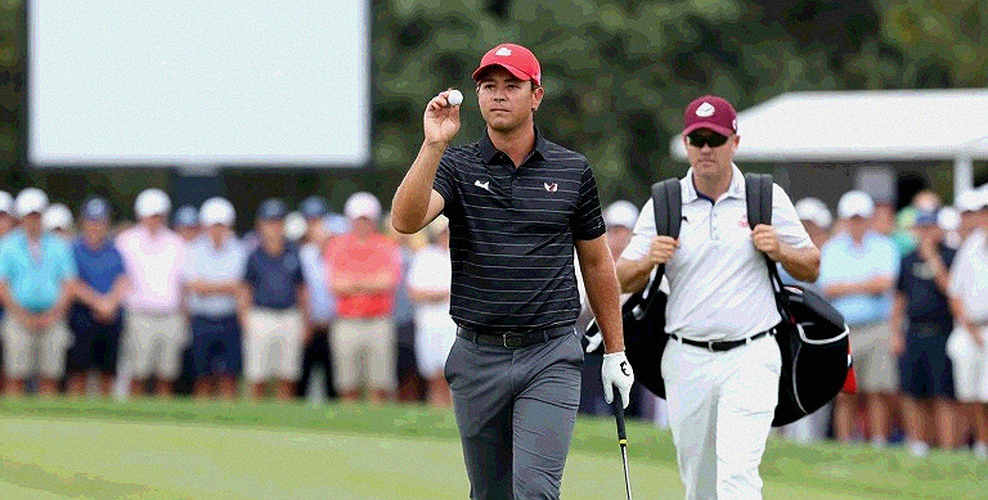
I had the number everyone else had — 269. I did not have the numbers that explain it. How many strokes she gained on approach across three rounds. Whether her putting held through the last nine holes on a Sunday. What she did on the par-fives. I built all of it by hand: counting birdies off the scorecard, pairing greens in regulation with putts, matching bogeys to hole numbers. That thread reached 26,000 retweets. Nobody noticed its weakest link — the statistic that should have supported the whole argument did not exist, because on the Indian side of the story, nobody had recorded it.
I went back to the thread to see what I had missed. What I missed was not an argument. It was a void — the absence of shot-level data for an Indian golfer, a gap I could not fill because it had never been captured.
What the world counts, and what India counts
Every modern professional golf debate stands on Strokes Gained. It splits into four columns: off the tee, approach, around the green, putting. The arithmetic is simple — how much better or worse a player was than the tour average on every shot. What matters inside it is that approach correlates most tightly with scoring, and putting correlates most loosely. Putting is the most volatile category, which is why a one-week hot streak should never be extended in a straight line.
The whole structure comes from ShotLink, running on the PGA Tour since 2026, logging the location, distance and outcome of every shot. Third-party platforms like Data Golf turn that raw material into public analysis. Beneath it sits the economy of the Korn Ferry Tour, Q-School and the Tour Card; above it, OWGR points and the routes into the majors — the Green Jacket at Augusta, the punitive U.S. Open setup, the weather lottery of the links rota at The Open, and the FedExCup's Starting Strokes at the finale.
India has none of it. PGTI events run, cuts fall, and a missed cut pays no prize money and no ranking points. But at no Indian event is it recorded which player gained strokes on approach and which bled them off the tee. I felt this first in 2026, when the stadiums had emptied and the only live sport in Pune was golf. The only live sport in Pune taught me to watch without a crowd.
That year I built a one-page glossary — cut line, par, purse, co-sanctioned, Order of Merit. I did not want to write anything I could not understand again. I did not pivot to golf; I pivoted to paying attention. It is why, whenever someone tells me Indian golf lacks talent, my first question is: measured against what?
The core argument: the debate is narrative because the number is never filed
December 2026, Poona Club Golf Course, my first press tent. Fifty-four holes, par 72, a purse of ₹30 lakh, the cut falling at even-par 144. I followed one twenty-two-year-old rookie for three rounds and built a paper grid — fairway hit or missed, green in regulation or not, putts. After three rounds I had a hand-built scrambling rate.
What I did not have was the why. Rough was thin at Poona Club, so a drive that missed the fairway cost him almost nothing. On another course the same drive costs half a stroke. I could not tell you where he lost his strokes, because I had no baseline for the field. The spreadsheet was not the story; it was the confession — it admitted that I was writing a player's diary, not an analysis.
To understand the cut you have to understand the money, and this is where Indian golf leaves its real receipt. In a ₹30 lakh purse the winner's share runs around fifteen to sixteen per cent — roughly ₹4.5 lakh before tax. Fortieth place might pay ₹30,000. Miss the cut and you get nothing, while still paying the Pune-to-Kolkata-to-Bengaluru airfare, the hotel, the caddie, the food.
Where the scoreboard shows, the sponsor is the actual document. The engine of Indian professional golf is not the PGTI; it is companies like Hero, DLF and Tata Steel. Every purse is a CSR line item. The calendar is decided in board rooms, not by competition. Nobody buys shot-level data for a tournament whose title sponsor is still deciding next year's budget. The data question sits downstream of the money question, and the money comes first.
On the women's tour the arithmetic tightens while the results keep arriving. Aditi Ashok's fourth in Tokyo is India's highest international finish of the decade. Diksha Dagar won on the Ladies European Tour in 2026, and Tvesa Malik became a regular there. Together they collect a fraction of the column inches one good week gives a male professional.
There is no sentiment here, only accounting. Regular Hero Women's Professional Golf Tour events have generally sat in the ₹10–15 lakh purse range, while men's PGTI events start at ₹30 lakh and climb well beyond. The coverage gap is far wider than the purse gap. Both share one thing: no shot-level data anywhere. I tried to apply the same statistical rigour to Aditi, Diksha and Tvesa that I apply to men's events, and hit a wall every time — the evidence I needed lived in federation press releases, not in numbers.
To see where this void comes from, I had to look at the country I was born in — carefully. Golf's mass base in Korea grew because public driving ranges and indoor screen-golf simulators were within reach of ordinary people. Courses were expensive; practice was cheap. India went the other way — more than two hundred courses, largely built for members, with practice space still a privilege.
This is not an argument that India should try harder. It is a description of two different structures. One country built a public pipeline into a global pipeline. The other built membership courses and called it a legacy. The Indian players who do emerge often come through caddie programmes at a handful of clubs, where a family member already works. Green fees and membership waitlists lock out everyone else. That is the real story, not talent.
I have tripped over this void before. In September 2026, as a twenty-year-old Pune university student, I wrote a twelve-part thread on India's under-17 World Cup match against Colombia — on Jeakson Singh's 82nd-minute header, India's first FIFA tournament goal in a 1-2 defeat. I froze the frame, circled the six-yard box, counted three Colombian defenders ball-watching. That thread reached 4,800 retweets. I learned that a thread lives or dies on its third tweet, the one you can defend in a reply.
At Russia 2026 the habit paid off. I built a spreadsheet of 64 matches and 169 goals, tagging every goal by minute, build-up type, set-piece or open play, and the scorer's club. What fell out was that 43 goals arrived after the 75th minute, and the popular tired-legs explanation was really a substitution-pattern story. My thread 'The World Cup Was Won at Minute 76' was shared eleven thousand times. The spreadsheet earned the work, not the headline. Somewhere between the header and the spreadsheet, the myth got legs.
I now apply the same spreadsheet thinking to golf, and every time I find empty columns. The cut math exists — top sixty-five and ties after thirty-six holes, nothing beyond. OWGR points exist. Purses exist. What is missing is the part that explains who did what and why. Inside that void, talent and luck cannot be separated, and that is why every Indian golf argument eventually collapses back onto personality: he has it in him, his head is not in it.
Where I could be wrong
The strongest counter-argument is aimed at me: data measures a problem, it does not fix one. If a sponsor's appetite stops at ₹30 lakh, buying ShotLink is not the best use of that purse. Ten junior players could be funded for a year instead. Data does not build a driving range, and India's shortage of ranges is a bigger problem than its shortage of data.
A second counter-argument is that this void protects Indian golf. The day a ₹2 crore event publishes shot-level data, agents and foreign players will read it and enter the field. The space a local rookie gets is slightly larger precisely because nobody is measuring him. This one makes me uncomfortable, because it hides an assumption — that Indian golf needs the protection of weak data and weak fields.
A third argument lands on my own position. I was born into a country with public ranges and screen golf, so the Korea comparison comes naturally to me. That comparison should not tell me where I stand; it can only show a difference.
And one correction, filed before anyone else could catch it. In December 2026, after that Pune event, I tweeted that a ₹30 lakh purse was not even one golfer's signing bonus. I had one digit wrong in the winner's cheque. I deleted the tweet, published the corrected split, and folded the reply thread into a later piece. I kept the receipts because the story kept changing. Calling ₹30 lakh very little is easy. Letting it stay ₹30 lakh and then arguing with it is harder.
There is another trap I want to avoid. It is true that the women's data is thinner than the men's, but writing that up as a women's golf data crisis would repeat the very coverage failure I am complaining about. Aditi's fourth place is not a sympathy story. It is an execution — of 269, one shot outside a medal playoff in 2026, ahead of players with major titles and Olympic medals.
Forward
My prediction is simple and it can be broken into three concrete signals. Over the next eighteen months, watch whether even one PGTI event publishes hole-by-hole shot data; whether any regular Hero Women's Professional Golf Tour purse crosses ₹25 lakh; and whether any state association publishes its own green fees and membership waitlist data.
If two of the three move, Indian golf's debate will shift from story toward number within a few years, and we will be able to say he gained two strokes on approach instead of he has it in him. If none move, a rookie's story will be written in 2030 the same way I wrote one on a paper grid in 2026. The feed rewards certainty; the archive rewards correction. Indian golf has no archive — so it allows nobody to correct it, and nobody to prove it.
A year after that 269, I reopened my one-page glossary file and added a column: 'not recorded.' Its longest entry is not a name. It is an entire year. If the smallest number of the biggest story is not on file, what exactly are we arguing about — the player, or the empty space where his number should have been?