
होमField HockeyAsian Champions Trophy: India's 5-2 win over China is real, but the 'strong in all quarters' claim isn't backed by the numbers
Asian Champions Trophy: India's 5-2 win over China is real, but the 'strong in all quarters' claim isn't backed by the numbers
मुख्य तथ्य (एशियाई चैंपियंस ट्रॉफी, पुरुष, छह-टीम राउंड रॉबिन): भारत ने भुवनेश्वर के ओलंपियन सुरजीत सिंह हॉकी स्टेडियम में चीन को 5-2 से हराया। यह भारत की लगातार दूसरी जीत है और टीम अंक तालिका में शीर्ष पर है। इससे पहले भारत ने बांग्लादेश को 13-0 से हराया था, यानी दो मैचों में स्कोर 18-2। गोलकर्ता: हरमनप्रीत सिंह (2), सुखजीत सिंह (2), जुगराज सिंह (1)। चीन ने हाफ टाइम से चार मिनट पहले 1-1 की बराबरी की थी, जिसके एक मिनट बाद हरमनप्रीत ने पेनल्टी कॉर्नर से भारत को फिर आगे किया; ब्रेक के तुरंत बाद भी उन्होंने गोल किया। महत्वपूर्ण आंकड़ा: भारत के पांच में से तीन गोल पेनल्टी कॉर्नर से आए यानी 60 प्रतिशत, जो अंतरराष्ट्रीय सामान्य दायरे (30-50 प्रतिशत) से अधिक है। दूसरी ओर घरेलू मैदान पर कमजोर प्रतिद्वंद्वी के खिलाफ दो गोल खाना रक्षात्मक समीक्षा का संकेत है। क्या उपलब्ध नहीं है: पजेशन, शॉट, सर्कल एंट्री, जीते गए पेनल्टी कॉर्नर की संख्या, कार्ड या रेफरल की जानकारी उपलब्ध नहीं है। इसलिए पेनल्टी कॉर्नर की दक्षता और रक्षा के प्रदर्शन पर ठोस निष्कर्ष संभव नहीं। 'चारों क्वार्टर में मजबूत' वाला दावा आंकड़ों से समर्थित नहीं है; एकमात्र क्वार्टर-विशिष्ट घटना चीन का हाफ टाइम से पहले किया गया गोल है, जो दावे के उलट है। संदर्भ: मुख्य कोच क्रेग फुल्टन; भारत मेजबान है; टूर्नामेंट से ओलंपिक कोटा नहीं मिलता (एशियाई खेलों का स्वर्ण पदक सीधा ओलंपिक टिकट देता है), इसलिए इसका मूल्य तैयारी और रोटेशन में है, रैंकिंग में नहीं। भारत FIH रैंकिंग में शीर्ष पांच के दायरे में, चीन टॉप-20 से बाहर (मौजूदा सूची से पुष्टि की जानी चाहिए)। अगली सच्ची परीक्षा यूरोपीय या ऑस्ट्रेलियाई शीर्ष टीमों के खिलाफ होगी।
Bhubaneswar: India beat China 5-2 at the Olympian Surjit Singh Hockey Stadium in the Asian Champions Trophy, their second successive win of the six-team round robin, which took the hosts to the top of the table. India had earlier beaten Bangladesh 13-0, so two matches read 18 goals scored and two conceded. Five goals, a captain's double and first place — from the outside the picture looks flawless. Inside the match, two facts complicate it: three of India's five goals came from penalty corners, and at home against a lower-ranked opponent they conceded twice.
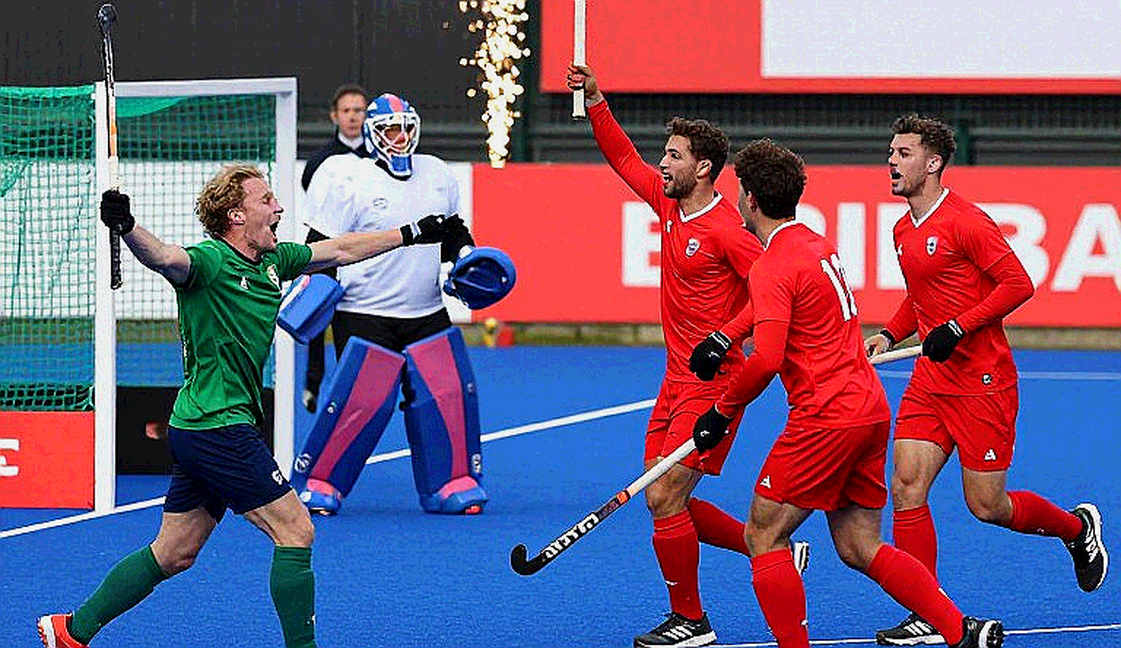
India scored first to take the lead. China equalised four minutes before half-time, but Harmanpreet Singh restored the advantage from a penalty corner a minute later and India went into the break 2-1 up. Harmanpreet scored again immediately after the interval. India's five goals came from Harmanpreet (two), Sukhjeet Singh (two) and Jugraj Singh (one), while China scored their second goal later in the same match. After half-time India scored three and conceded one. The most important detail in that sequence is not the score but the timing: two goals arrived at moments when the opposition had, or was about to build, momentum.
For China, this was not a wholly one-sided contest. They were within one goal at half-time and scored twice. That is a modest positive signal for the Chinese men's programme, but it should not be read as a shift in the landscape. China are not yet part of the global medal conversation. For India, the implication is that conceding twice at home to a mid-tier side is something that needs review, even if the final margin was five goals.
The report's headline claims India were 'strong in all quarters'. The phrase reads well, but the match report contains not a single figure that can weigh four quarters separately. The only quarter-specific event recorded is China's equaliser, four minutes before half-time — that is, a lapse late in the second quarter. That is evidence against the claim, not for it. 'Strong in all quarters' should therefore be treated as editorial colour, not a tactical finding. Assessing four quarters properly requires shot, circle-entry and possession data for each of them; the available material has none.
Three of India's five goals came from penalty corners — a 60 per cent share. Internationally, penalty corners typically account for 30 to 50 per cent of goals. Sixty per cent is neither good nor bad in itself; it is a structural signal. It means the route to goal from open play exists but was used sparingly. Against a side like China the balance works, because the pressure to avoid circle fouls is constant. Defences like Belgium's, the Netherlands' or Australia's concede far fewer circle fouls, and consequently concede fewer corners. A three-fifths set-piece share is then a warning rather than a strength.
Harmanpreet's two goals say something about captaincy. The first came a minute after China's equaliser, the second immediately after the break. Both were moments when the opposition had momentum or the chance to build it, and both times India answered on the scoreboard at once. That is a good sign for any team, especially when the answer comes from a set-piece. But it is evidence from one match. Calling it a 'pattern' requires repetition across several games; turning one performance into a theory about a captain's capacity under pressure would be premature.
Jugraj Singh's name on the scoresheet is a technical signal too. It means India had a second drag-flick option beyond Harmanpreet. At the top level that is standard practice, because the first runner is already leaning towards Harmanpreet. A second flicker breaks that anticipation and makes the goalkeeper's decision harder. It is a small detail, but it shows that India's set-piece plan does not depend on one individual. This is why 'penalty-corner dependency' must be separated from personal dependency: the dependency is on the set-piece, not on one person.
The number that most deserves attention is the two conceded. A top-five side at home against a lower-ranked Asian opponent typically concedes none or one. Conceding twice means gaps appeared somewhere in the defensive structure. The problem is that the available report does not say whether those goals came from open play, from penalty corners, or after the Indian press was broken. Without that information, nothing firm can be said about the defensive line or the goalkeeper. The most informative statistic in this match is not the five; it is the two.
The biggest limitation is the data. There is no possession figure, no shot count, no circle-entry count and no number of corners won. That gap matters enormously. Suppose India won 12 corners and scored three — a 25 per cent conversion rate. Suppose they won four and scored three — 75 per cent. Both scenarios produce identical goal counts and completely opposite conclusions. Until the number of corners won is known, any comment on penalty-corner efficiency is speculation.
It is also worth noting that this absence of information is a limitation of the source, not a matter of secrecy. The available material reads like a short agency-style report, with no mention of a player of the match, goalkeeper saves or standout defensive moments. That does not mean nothing of the sort happened; it means the available account does not record it. The distinction between 'not reported' and 'did not happen' matters.
There is no information on discipline either. In hockey a green card means two minutes and a yellow card five to ten minutes a player short, and that can swing a match more than in most team sports. The report mentions no card, no video referral and no umpiring controversy. If the match genuinely finished without cards, that is a positive — the full squad stays available and rotation is unconstrained. But since this is not confirmed, it is better treated as a possibility than as a clean disciplinary record.
The 13-0 win over Bangladesh was an outlier in every sense. Goal difference matters in a six-team round robin because it decides the table when points are level. Those 13 goals therefore contributed materially to India's position at the top. But that match has almost no diagnostic value for performance assessment. A 13-0 result cannot be repeated, and a margin of that size is close to impossible against ranked opposition. India's top spot is thus partly manufactured by that one result.
Form conclusions need caution. Two wins and 18 goals are facts, but 13 of those 18 goals came against the weakest team in the field. The '18 goals in two games' framing hides opponent quality. Likewise, the win over China was comfortable but included two concessions. Until shot, possession and corner data surface, it cannot be determined whether the scoreline overstates or understates the performance. Two matches is a sample far too small for any long-term conclusion.
The competition's tier needs to be placed correctly. The Asian Champions Trophy is a continental event, second-tier in global competitive weight. It offers no Olympic berth — the Asian Games gold medallist takes the direct Olympic ticket. Ranking points are modest, so beating China and Bangladesh is unlikely to move India's world ranking much. The tournament's real value is preparatory: testing rotation, rehearsing penalty-corner variation, building team chemistry. For the same reason, a defeat here would cost India very little structurally; the true test is behavioural, not the result.
The remaining round-robin fixtures matter for semi-final seeding, not qualification. Finishing top of the table offers an easier semi-final, and in a six-team format that difference is practically significant. Over the coming matches, two things should be watched: whether open-play goals increase, and whether the gaps in defence narrow. Those indicators will be worth more than the scoreline, because a scoreline can also be manufactured by a weak opponent.
Hosting is a signal in itself. The tournament is being played in Bhubaneswar, at the Olympian Surjit Singh Hockey Stadium — one of India's principal hockey hubs. Home turf, home crowd and familiarity with the surface all favour India. Eastern India's heat and humidity affect both teams, but acclimatisation benefits the host. More importantly, the regular staging of international events in Odisha demonstrates the strength of the state-sponsored hockey model, which most Asian federations cannot match. This is not just logistics; it is a display of ecosystem strength.
On the calendar, India played Bangladesh on Tuesday and China on Thursday — roughly 48 hours apart. That is precisely the format that tests bench depth. The question, then, is how many minutes key players were given in a one-sided 13-0 game. If Harmanpreet played heavy minutes in that match, it would be a management red flag. The available report does not say either way, so the question stays open, but the rotation pattern in the coming matches will answer it.
The team's structure reflects head coach Craig Fulton. His coaching background comes from the Irish and Belgian school, which emphasises an organised block and quick transitions. In the Indian team that structure has been combined with the players' natural flair — a hybrid, not a wholly new invention. In the flow of the match, Fulton's influence shows more in the timing than in the scoreline. Scoring immediately after conceding and immediately after the break suggests the team has drilled restart moments specifically.
Hockey's four-quarter format (four 15-minute periods) makes that skill more valuable. The interval between quarters is a direct opportunity for a coach to adjust. Scoring immediately after the break is an exploitation of that window. The self-pass rule introduced in recent years also rewards quick restarts and benefits teams that can sustain pressure through fitness and discipline. On the other side, a 60 per cent reliance on penalty corners is a risk that varies with rules and officiating standards — circle-foul whistling tightens at the Olympics and World Cup.
In the global picture, India sit in the medal-challenger band. Title contenders are the Netherlands, Belgium, Australia and Argentina. Alongside India in the medal-challenger bracket are Germany, England/Great Britain and Spain or New Zealand. Below them come China, Pakistan, Bangladesh and the Japan/Korea/Malaysia group. India's position within the band is stable; its ranking inside it is not. India sit in the top-five area of the FIH rankings while China are outside the top 20, though both figures should be checked against the current ranking list.
Continental dominance and global medals are two different currencies, and this match evidences only the first. Beating China 5-2 and Bangladesh 13-0 confirms India's hierarchy in Asia. It says nothing about whether the gap to Europe's and Australia's top four has closed. That distinction matters, because drawing global conclusions from continental wins would be a category error.
The route to the top tier runs through open-play conversion and defensive economy, not penalty corners. The 60 per cent corner share and the two concessions describe exactly the two variables that separate medal challengers from title contenders. The good news is that both are fixable and both have been identified. The bad news is that opponents like these do not expose those weaknesses, so the pressure to fix them is felt less.
A 'golden generation' label would also be premature. The available facts describe a team that plays under its captain and inside a clear system, not a cohort of stars peaking simultaneously. The accurate framing is a structured team with one world-class set-piece specialist and a few players capable of creating chances in open play. That description is less exciting, but it is more precise and more useful for planning.
Three risks stand out. First, a deep, low-foul block can cut off penalty corners altogether, and then open-play scoring will face its real examination. Second, conceding twice at home to a weaker side raises questions about defensive balance, especially when full-backs join the attack and leave space behind. Third, there is no card or discipline data, and in hockey a single green or yellow card can turn a match.
There is no need to dismiss this win. Five goals, top spot and the ability to keep applying pressure after the break are all real. But treating the win as a guarantee of the future would be wrong. The scores against China and Bangladesh indicate India's current standing, not its ceiling. The next genuine test will come against a side that does not foul in the circle and knows how to take its chances. Until then, the 5-2 is on record — and so are the two questions.

संबंधित खिलाड़ी
लोकप्रिय/पसंदीदा पुस्तकें
Asian Champions Trophy: India's 5-2 win over China is real, but the 'strong in all quarters' claim isn't backed by the numbers2026-10-31
Sultan of Johor Cup final: Malaysia win 4-3 on shootout as Pakistan's 2-0 lead freezes after the 21st minute2026-10-25
India 5-2 China: The Most Important Number in This Win Isn't on the Scoreboard2026-10-30
Trinity–Thomian Hockey, 20th Edition: What Happened at the Astro Turf, and What Never Made the Record2026-10-29
अनुशंसित
Trinity–Thomian Hockey, 20th Edition: What Happened at the Astro Turf, and What Never Made the Record2026-10-29
Sultan of Johor Cup final: Malaysia win 4-3 on shootout as Pakistan's 2-0 lead freezes after the 21st minute2026-10-25
India 5-2 China: The Most Important Number in This Win Isn't on the Scoreboard2026-10-30
Sultan of Johor Cup 2026 final: Malaysia's trophy was built in the 49th minute, the shootout only stamped it2026-10-25
अनुशंसित
Johor Bahru: Malaysia Beat Pakistan 4-3 in Shootout, But the Final's Real Story Is Hidden in the Second Rebound of Penalty Corners2026-10-26
India 5-2 China: The Most Important Number in This Win Isn't on the Scoreboard2026-10-30
Trinity–Thomian Hockey, 20th Edition: What Happened at the Astro Turf, and What Never Made the Record2026-10-29
Sultan of Johor Cup 2026 final: Malaysia's trophy was built in the 49th minute, the shootout only stamped it2026-10-25
Sultan of Johor Cup 2026 Final: Malaysia Beat Pakistan 4-3 in Shootout After 2-2, Green Shirts Squander 2-0 Lead2026-10-25
The 20th Trinity–Thomian on Colombo's Astro Turf: The Penalty-Corner Economy Behind the School Pride2026-10-25
अनुशंसित
Asian Champions Trophy: India's 5-2 win over China is real, but the 'strong in all quarters' claim isn't backed by the numbers2026-10-31
Six Teams, Seven Days, Five Matches: Bangladesh Hockey's Real Opponent Is the Calendar2026-10-24
Sultan of Johor Cup final: Malaysia win 4-3 on shootout as Pakistan's 2-0 lead freezes after the 21st minute2026-10-25
India 5-2 China: The Most Important Number in This Win Isn't on the Scoreboard2026-10-30
The 20th Trinity–Thomian on Colombo's Astro Turf: The Penalty-Corner Economy Behind the School Pride2026-10-25
Sultan of Johor Cup 2026 final: Malaysia's trophy was built in the 49th minute, the shootout only stamped it2026-10-25