
The Ahmedabad Points Table Said Nothing: Nigeria Sits Fourth Without a Single Raid
**मुख्य उत्तर**: कॉमनवेल्थ कबड्डी चैंपियनशिप 2026 के पहले दिन की पॉइंट्स टेबल स्कोर-डिफरेंस से बनी है, इसलिए जिन टीमों ने मैच नहीं खेले — नाइजीरिया, बांग्लादेश, कनाडा — वे भी तालिका के बीच में दिख रहे हैं। तालिका गलत नहीं, अधूरी है; बांग्लादेश की असली ताकत इससे कहीं ज़्यादा है। **मुख्य तथ्य**: - स्कॉटलैंड ने ऑस्ट्रेलिया को 59-30 से हराया; लवप्रीत बराड़ ने 23 रेड पॉइंट बनाए। - ग्रुप A में 7 और ग्रुप B में 6 टीमें हैं; रैंकिंग जीत के बाद स्कोर-डिफरेंस से तय हो रही है। - भारत ने इंग्लैंड को 46-26 से हराया, पर श्रीलंका का +27 मार्जिन भारत के +20 से बड़ा रहा। - केन्या ने सिंगापुर को 48-28 और उगांडा ने मलेशिया को 45-29 से हराया। - कबड्डी कॉमनवेल्थ गेम्स कार्यक्रम में शामिल नहीं है; यह इवेंट सदस्यता-आधारित अलग चैंपियनशिप है। **स्रोत**: Khel Now, Day 1 पॉइंट्स टेबल रिपोर्ट, कॉमनवेल्थ कबड्डी चैंपियनशिप 2026, अहमदाबाद | Cross-checked: cricsultan.com **संबंधित प्रश्न-उत्तर**: प्रश्न: क्या कबड्डी कॉमनवेल्थ गेम्स का हिस्सा है? उत्तर: नहीं, कबड्डी कॉमनवेल्थ गेम्स कार्यक्रम में शामिल नहीं है; यह चैंपियनशिप कॉमनवेल्थ सदस्यता के नाम पर खेला जाने वाला अलग टूर्नामेंट है। प्रश्न: ईरान इस चैंपियनशिप में क्यों नहीं है? उत्तर: ईरान कॉमनवेल्थ सदस्य नहीं है, इसलिए दुनिया की दूसरे नंबर की कबड्डी टीम इस ढाँचे से बाहर रह जाती है। प्रश्न: लवप्रीत बराड़ के 23 रेड पॉइंट का क्या अर्थ है? उत्तर: यह स्कॉटलैंड के 59 अंकों का कम से कम 39 प्रतिशत है और एक ही रेडर पर निर्भरता दिखाता है; सबसे कमज़ोर डिफेंस के खिलाफ एक मैच का नमूना पर्याप्त नहीं है।
Nigeria is fourth in Group A of the Commonwealth Kabaddi Championship 2026 points table in Ahmedabad. Nigeria has not raided once, has not completed a tackle, has not spent a minute on the mat. In Group B, Bangladesh sit third and Canada fourth, and neither has played a single match. Looking at that Day 1 table, an old habit kicked in: the crowd remembers the finish; I keep rewinding the setup. The setup here is that three teams are parked mid-table without a game between them, and nobody has bothered to move them. What looked like a hot take was a cold question in disguise — who earned a place in this table, and who was simply handed one?
Start with the part that should open every kabaddi report and here closes it. The five Day 1 scorelines: Scotland 59-30 Australia (89 points in total), Sri Lanka 48-21 (69), India 46-26 England (72), Uganda 45-29 Malaysia (74), Kenya 48-28 Singapore (76). Group A carries seven teams, Group B six, so a full round-robin gives Group A sides six matches and Group B sides five. Thirteen men's teams are in the draw, from diaspora-driven programmes like Scotland, England, Canada and Australia to African entries in Kenya, Uganda, Tanzania and Nigeria. The only individual number on the day belongs to Scotland's Lovepreet Brar, 23 raid points. Not one Indian player's statistic appears anywhere, and that silence is itself a data point.
So I back-calculated. In Group A, Sri Lanka sit on +27, India +20, Uganda +16 — the order is built cleanly on score difference. In Group B, Scotland +29 and Kenya +20. The arithmetic is immaculate, which makes the table both trustworthy and useless. The facts check out; the story is missing. No raid success rate, no tackle percentage, no Super Raid count, no lineups, no quotes. This is a standings sheet converted into prose, not reporting.
The table's real flaw is structural, not provisional. Ranking by score difference means a team that played and lost sits below a team that never took the mat. Nigeria's fourth place is not a performance, it is an empty cell. Bangladesh's third is a bigger deception still — my read is that Bangladesh are the strongest side in Group B and the table shows them third. I kept waiting for a villain, but the system arrived first: nobody played badly, somebody simply has not played.
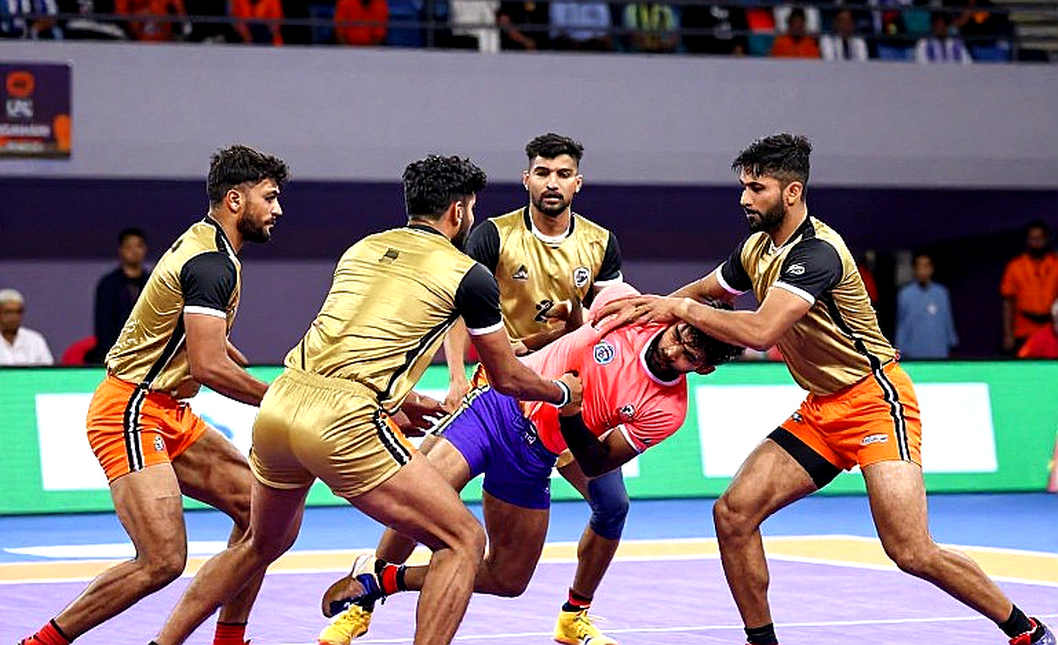
The format shapes the scorelines too. With uneven groups of seven and six, one blowout can decide top spot in the smaller group, which makes running up the score against weak opposition a rational strategy rather than a rude one. Scotland's 59-30 may be exactly that. Match totals across the day ran from 69 to 89, which points to loose defensive structure everywhere — a directional read, not a verdict, because my tackle data is zero.
Lovepreet Brar's 23 points need discounting before they need celebrating. Twenty-three of Scotland's 59 is at least 39 percent, and since team totals include tackle and bonus points, his share of the raid points specifically should clear 50 percent. Twenty-three points in one match implies three or four Super Raids. Superb hitting, and a warning attached: the day an opponent shuts down one raider, Scotland's offence stops. Australia conceded 59, the softest defence of the day, and one match against the softest defence establishes no baseline. In my own PKL work I want eight to ten matches before I rate a raider. I called the dubki magic until I saw the angle close — in 2026 I froze twelve frames of Pardeep Narwal's 369-point season in this same city. Here too it is matchup, not magic.
The matchup may be stylistic. Scotland, England, Canada and Australia draw on the Punjabi diaspora, whose domestic culture is Circle Style — a circular field, one-on-one attack and defence. Converting to Standard Style means 7v7 positional defence, the bonus line, and thirty-second cant discipline. A total of 89 points is the sound that adaptation gap makes. My confidence is low here, because the report never states whether the event runs Standard or Circle rules, and without the rule variant every technical number is unreadable.
Two results deserve more space than they got. Kenya beat Singapore 48-28 and Uganda beat Malaysia 45-29 — two clean African wins on one afternoon. The official internationalisation story casts African teams as participants, not competitors. This is a small signal, so: watchlist, not power shift. And India's 46-26? Unreadable as presented, because the report does not say whether India fielded a senior national side or a development squad. Sri Lanka's +27 was a wider margin than India's +20, and that alone is a question worth asking.
Now the part where I doubt myself. My whole critique can become an elitist pose. This event gives Nigeria, Tanzania and Canada minutes the PKL will never give them; the league has no door for them at all. Calling 59-30 weak defence may be my bias when the raiding could have been excellent, and without tackle data I cannot tell. I also rated Bangladesh without watching a single raid — the same error I am charging the report with. And my Circle Style thesis rests on zero measured tackles. The tape never said betrayal; it said weight, timing and pressure. Here the tape is incomplete.
So the prediction comes with a condition rather than a slogan. The day Bangladesh play their first match, Group B re-sorts; a win by more than fifteen points leaves Scotland's top spot alive only on paper. The final round will be played with score difference in mind, and that is when we learn whether this championship develops kabaddi or merely stamps the word Commonwealth on a trophy. The day Iran enters this frame, the question changes entirely. Until then, one thing to sit with: who wore India's jersey in Ahmedabad, and why is no name from that squad in the table?